
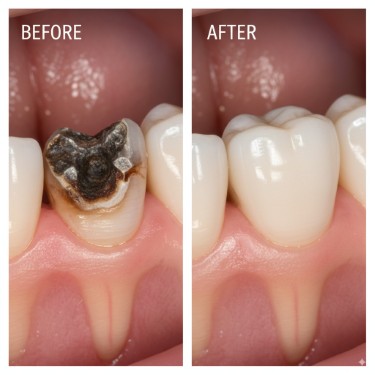
Detecting cavities between teeth in Chandler, AZ, involves using X-rays, explorers, and staining techniques to identify hidden decay that visual exams might miss, especially in tight spaces.
At Martin Dental, we utilize these diagnostic methods to determine when dental fillings are necessary, helping patients understand how early detection supports their oral health.
Service Standards to Discuss
-
Examine the teeth for visible signs of decay and surface discoloration that may indicate cavities.
-
Discuss the use of diagnostic tools, such as X-rays, to identify areas of decay between teeth not visible to the naked eye.
-
Confirm findings with tactile investigation using dental explorers to detect soft or sticky spots on the tooth surface.
-
Assess staining or surface changes that could suggest underlying cavities, supporting clinical decisions for treatment.
What to Know About Dental Fillings
When detecting cavities between teeth, we rely on several methods beyond visual inspection. X-ray detection, specifically bitewing radiographs, allows us to see areas of decay that are not visible to the naked eye, especially in hard-to-reach spaces.
During a dental exam, our clinicians may also use a dental explorer—a thin, pointed instrument—to gently feel for soft spots indicating decay. Staining can sometimes highlight areas of enamel breakdown, but it is not definitive.
Dr. Martin and our team evaluate these findings collectively to confirm whether a cavity requires filling, considering the patient's comprehensive oral health and risk factors.
Keyword Pool
In our dental fillings service, terms like cavity fillings and tooth-colored fillings describe the restorative materials used to repair decayed teeth.
Composite fillings are a popular option because they blend smoothly with natural tooth color, providing an aesthetic result.
When cavities develop between teeth, they are often detected through X-ray imaging, tactile exploration with dental tools, or staining, allowing Dr. Ma to accurately identify and treat decay before it worsens.
Assessment and Service Options
When detecting cavities between teeth, our dentists perform a thorough clinical evaluation. We use a dental explorer, a handheld instrument, to feel for soft or sticky areas that indicate decay.
Staining on the tooth surface can also reveal areas of concern, while high-resolution X-rays help visualize cavities hidden between teeth that are not visible to the eye.
Dr. Brett Martin in Chandler relies on these diagnostic tools to determine whether a filling is needed. The findings guide the decision to remove decay and restore the tooth with a filling.
Questions Before Booking
How do dentists identify cavities between teeth during a check-up?
Dentists typically use a combination of visual examination, dental explorers, and staining techniques to detect cavities between teeth.
An explorer is a dental instrument used to feel for soft spots or rough areas that may indicate decay.
Furthermore, high-resolution X-rays, such as CBCT scans, can reveal hidden cavities that are not visible to the naked eye.
Should I ask the dentist about the type of filling used for cavities between my teeth?
Yes, it’s advisable to discuss the materials and techniques used for filling cavities.
Different types of dental fillings—such as composite resin or amalgam.
Why Choose Martin Dental
Martin Dental has served the East Valley for 15+ years with three offices in Queen Creek, Chandler, and Mesa.
Dr. Brett Martin, Dr. Chapin Smith, and Dr. Adam Kenney provide thorough care using in-house labs and digital scanners.
We accept most insurance plans.

Request Your Consultation
Schedule an appointment at Martin Dental. Call us in Chandler at 480-867-4578, in Queen Creek at 480-867-4578, or in Mesa at 480-507-3534. You can also reach out to us online.
Our goal is stress-free care under one roof.
Locations: Queen Creek, Chandler and Mesa, AZ.
Get Started
Fill out form below